

About Omni
Omni is the semantic foundation that AI agents need to understand and act on business data. The majority of Omni's sales deals involve replacing an incumbent analytics tool, so knowing what a prospect actually uses, and how deeply that tool is embedded across their org, is essential to their GTM success.
The challenge: an insights gap at the core of outbound
Before Sumble, Omni's go-to-market team had several data sources. But none of them answered the questions that actually mattered: which companies use which BI tools, how deeply are these tools used, and who owns the BI tool buying decisions.
Which tools and how deeply?
What does the data team look like?
Who owns the buying decision?
What made Sumble stick
Most data vendors offer a thin, opaque view into a company. Traditional technographics providers merely tell you that an account "may" use a tool with no way to understand the reasoning behind that inference.
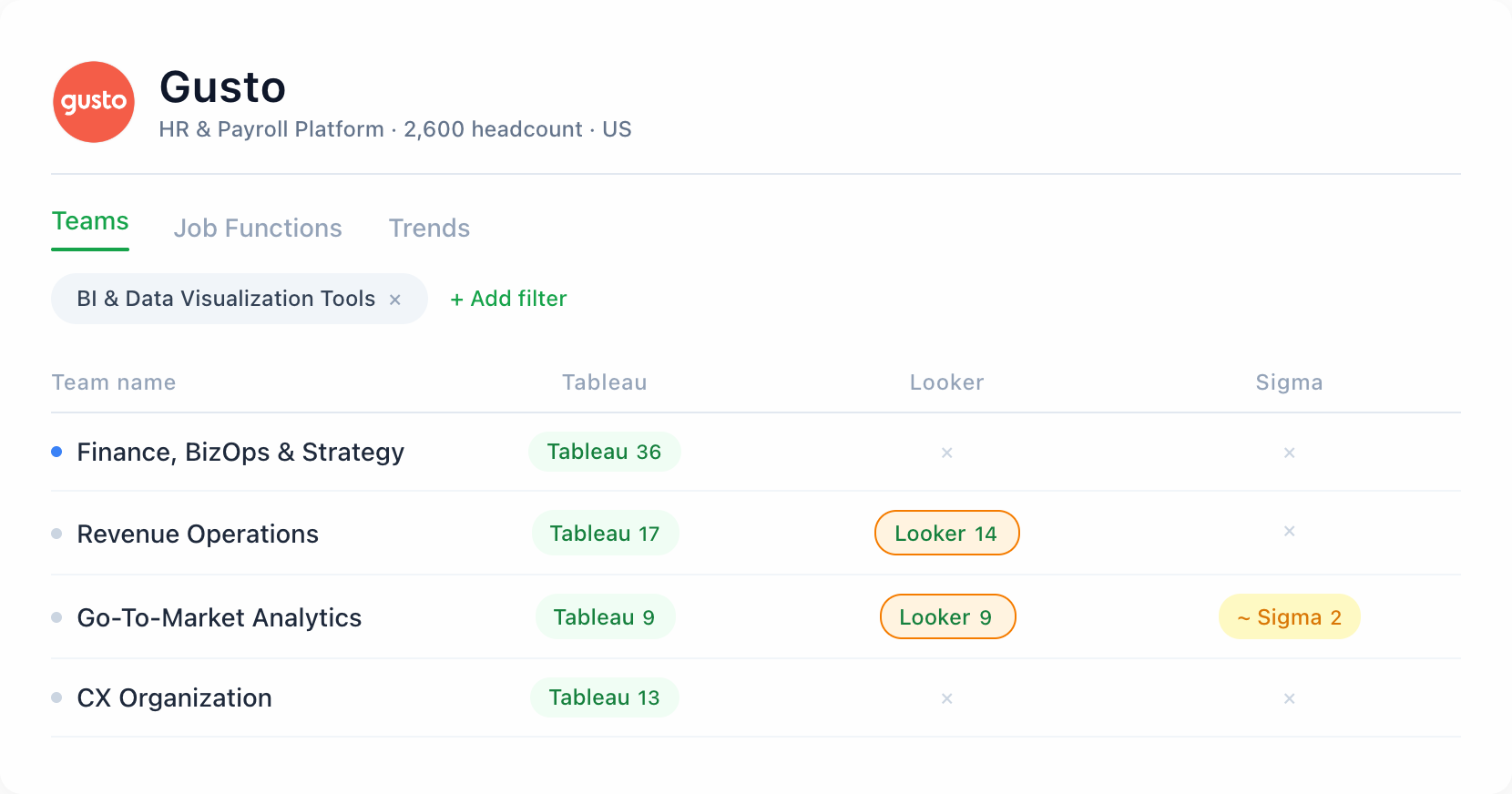
Sumble shows the account's tech stack down to which team uses what tool, giving reps the confidence to reach out to the right person with a relevant message.
What Omni sees in Sumble
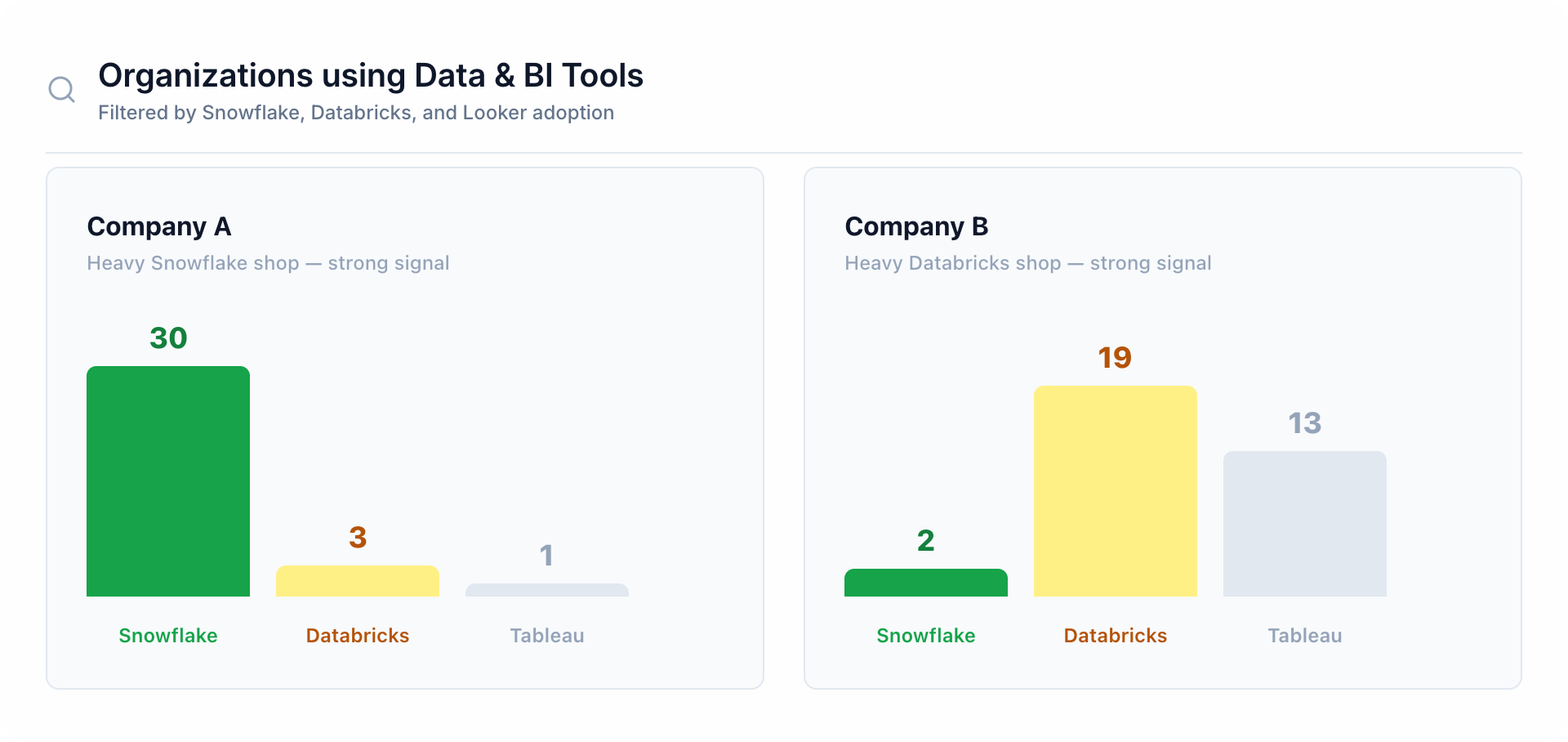
Omni doesn't just see that an account "uses Snowflake." They see that the account is heavily invested in Snowflake with a few teams on Databricks. The central data engineering team manages the BI tooling, and a separate financial analytics team runs Looker independently.
And the person who owns the BI relationship? Someone with the title Business Systems Lead, a title they'd never think to search for on LinkedIn Sales Nav.
Build vs. buy
Keerthi on Omni's Growth Engineering team previously led similar efforts at Rippling, and had already been through the build-vs-buy exercise. He was clear that building Sumble's rich graph of teams, people, jobs data, and tech stack data internally was not viable.
“You procure raw data, deposit it into a bucket, ingest it into a warehouse, apply modeling, and that's just the beginning. There's a long tail of data sanitization, standardization, entity recognition. Something as simple as understanding whether a job post indicates a BI tool migration or just team scaling is non-trivial.”
 Keerthi · Growth Engineering Lead, Omni
Three teams, three different jobs for Sumble
RevOps
Named account scoring
Used Sumble's data to build a named account scoring system for ICP-fit accounts.
- One of the first external datasets in the scoring model
- Without it, certain accounts wouldn't have been assigned or would have been assigned with low confidence
BDRs
Daily prospecting
Primary account research tool for the BDR team, connected to Salesforce.
- Reps pull assigned accounts and prioritize by technology
- Trace job posts to find the right person for each outbound sequence
Growth Engineering
Data platform layer
Pulls Sumble data into Snowflake as a base layer of their data platform.
- Feeds named account lists, audience segments for ad platforms, and TAM analysis
- Deep links back to Sumble give reps the full picture
Measurable impact across the GTM org
#1
BDR team adopted Sumble as their primary daily research tool
5x
Account research time: ~1 week for 200 accounts down to ~2 days
5 min
Per-account research: down from 20-30 min to 5 min per account
Sumble helps BDRs determine which outbound sequence a prospect should enter
About Sumble
Sumble is the GTM data-foundation you need to crush your pipeline goals in 2026. Use Sumble to get deep account intelligence — we show you exactly who to reach out to and what to say — by revealing the team structures, reporting lines, tech stacks, and active initiatives inside your target accounts.
You can use our Web app today (it's free), or get in touch with us to enrich your entire CRM, help you with account scoring, territory planning and white space mapping.